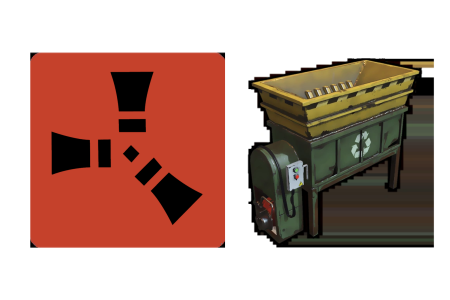

Welcome to the ultimate Rust Recycler Guide for 2024! Whether you're a seasoned player or just starting out, understanding recyclers in Rust is crucial for efficient resource management and survival. This guide will provide you with all the information you need, including what recyclers are, why they are important, how to use them, the best items to recycle for scrap, and detailed recycler locations across the Rust map.
Main Takeaways
- Recyclers convert unwanted items into valuable resources.
- There are lots of different places to recycle on the map.
- Different recyclers have varying levels of safety and scrap output.
- Recycling the right items can maximize your scrap earnings.
What is a Recycler in Rust?
Recyclers in Rust are machines that allow players to convert up to six stacks of items at a time into their base components. Once activated, the Recycler gradually processes the inserted items, breaking them down into their constituent parts. However, it is important to note that not all items can be recycled. Items that cannot be broken down will remain in the input hopper, untouched.
Prior to the Recycler Update, most items would decompose into a portion of the components used to craft them, typically yielding about 50% of the materials required for their creation. For items that break down into singular components, there is approximately a 50% chance of obtaining that component, depending on the type of recycler. (We'll go into more detail about this later.)
When operating the Recycler, it is crucial to understand that the process takes time. The more stacks of items you add, the longer the processing will take. This creates a potential risk, as (most of the time) using the Recycler does not shield you from PvP (player versus player) interactions. The audible noise generated by the Recycler can attract other players, who will hear it as an opportunity for easy loot. It is not uncommon for players to hide in nearby cover, waiting to ambush those using the Recycler. To mitigate this risk, stay out of sight while waiting for the Recycler to complete its task.
Why are Recyclers Important in Rust?
Knowing the locations of Recyclers is crucial for efficient resource farming in Rust. Recyclers play a vital role in quickly accumulating resources, especially in the early game when every minute counts. Establishing a secure starter base and learning blueprints requires a significant investment of resources, time, and Scrap. Understanding where to find Recyclers can help players maximize the efficiency of their farming efforts.
Many items obtained from boxes and barrels in roadside junkpiles can be broken down into additional Scrap when recycled. This makes Scrap farming more profitable. Additionally, these items can decompose into useful components such as Metal Fragments, wood, stone, cloth, High-Quality Metal, and other valuable items like gears or pipes. These resources are essential for accelerating early game progress.
Recycling not only boosts resource collection but also plays a critical role in inventory management. During a farming run, players often encounter a diverse array of loot, far exceeding their available inventory space. Frequent recycling helps consolidate loot into a more manageable stack of resources, reducing the need to leave valuable items behind due to limited inventory space.
How to Use a Recycler in Rust
Recyclers in Rust function as containers with designated input and output slots. Players can input up to six items to be queued for recycling. Stackable items can also be inserted, occupying only a single slot inside the Recycler.
To start the recycling process in Rust, follow these steps:
- Press the large green “Turn On” button. The Recycler will begin converting the input items into their base components over time.
- Wait for your items to recycle. Remember, it is important to remain vigilant when using a Recycler.
- Once the items are done recycling, put them in your inventory!
As the Recycler processes the items, the recycled components will appear in a specially reserved output space, which can hold up to six different item stacks. It is advisable to move these components to your inventory as soon as they appear to ensure continuous operation. The Recycler will automatically shut off if it runs out of input items or if there are no available output slots, functioning similarly to a furnace.
How to Use the Junkyard Car Recycler in Rust
In addition to regular recyclers, the Junkyard Car Recycler in Rust is a specialized recycling setup found in the Junkyard monument. It allows players to dismantle abandoned cars and convert them into useful resources like scrap, metal fragments, and other components. Using the Junkyard Car Recycler in Rust involves a few steps, but it's a highly efficient way to recycle vehicle parts and obtain valuable resources. Here's how you can get started:
- Gather Fuel: Before you begin, you'll need to have sufficient fuel. The Magnetic Crane used for recycling cars consumes a significant amount of fuel, so it's recommended to bring at least 50 low grade fuel, though more is always better.
- Operate the Magnetic Crane: Driving the Magnetic Crane is similar to driving a car in the game, but with added controls for the crane. Use the WASD keys for movement and hold the shift key to activate the crane controls.
- W/S: Moves the top part of the crane arm up and down.
- A/D: Turns the crane body.
- Left/Right Click: Moves the main crane arm down and up.
- Activate Headlights: If you're recycling at night, you can toggle the headlights with the ‘F’ key to improve visibility.
- Activate the Magnet: When you're near a car you want to scrap, press the ‘R’ key to activate the magnet. The magnet is effective at picking up nearby cars even if you're not directly on top of them.
- Transport the Car: Once the car is attached to the magnet, lift the arm up and drive over to the shredder located in the center of the Junkyard.
- Shred the Car: Hold the car near the shredder. The shredder will automatically pull the car in, grinding it up and dispensing the resources onto a conveyor belt. Ensure you have at least two players for this task—one to operate the crane and the other to collect the resources.
What are the Best Items to Recycle for Scrap?
Recycling the right items can maximize your scrap earnings. Some of the best items to recycle for scrap include:
- Tech Trash: High scrap yield and other valuable components.
- Electric Fuse: Good source of scrap and metal fragments.
- Rifle Body: High scrap output.
- Road Signs: Decent scrap yield along with metal fragments.
- Semi-Automatic Body: High scrap yield and useful components.
Below is a table showing the specific outputs for high yield components:
| Component | Safe Recycler Scrap Per | Non-Safe Recycler Scrap Per |
|---|---|---|
| Electric Fuse | 16 | 24 |
| Empty Propane Tank | 1 | 2 |
| Gears | 8 | 12 |
| Metal Blade | 2 | 3 |
| Metal Pipe | 4 | 6 |
| Metal Spring | 8 | 12 |
| Rifle Body | 20 | 31 |
| Road Signs | 4 | 6 |
| Semi Automatic Body | 12 | 18 |
| Sheet Metal | 7 | 10 |
| SMG Body | 12 | 18 |
| Tech Trash | 16 | 24 |
Where are Recyclers in Rust?
Recyclers are located at various points of interest across the Rust map. Knowing these locations can save time and improve your efficiency in gathering resources. Here is a detailed table of Rust recycler locations based on each monument:
| Monument | Recyclers Present | Safezone | Yield Bonus |
|---|---|---|---|
| Outpost | 3 | Yes | -20% |
| Bandit Camp | 2 | Yes | -20% |
| Power Plant | 3 | No | +20% |
| Airfield | 2 | No | +20% |
| Sewer Branch | 2 | No | +20% |
| Abandoned Supermarket | 1 | No | +20% |
| Arctic Research Base | 1 | No | +20% |
| Ferry Terminal | 1 | No | +20% |
| Giant Excavator | 1 | No | +20% |
| Large Harbor | 1 | No | +20% |
| Small Harbor | 1 | No | +20% |
| Junkyard | 1 | No | +20% |
| Launch Site | 1 | No | +20% |
| Light House | 1 | No | +20% |
| Military Tunnels | 1 | No | +20% |
| Mining Outpost | 1 | No | +20% |
| Oxum’s Gas Station | 1 | No | +20% |
| Satellite Dish | 1 | No | +20% |
| Train Yard | 1 | No | +20% |
| Water Treatment Plant | 1 | No | +20% |
| Abandoned Cabins | 0 | No | N/A |
| Abandoned Military Base | 0 | No | N/A |
| Large Barn | 0 | Yes | N/A |
| Large Fishing Village | 0 | Yes | N/A |
| Large Oil Rig | 0 | No | N/A |
| Nuclear Missile Silo | 0 | No | N/A |
| Dome | 0 | No | N/A |
| Ranch | 0 | Yes | N/A |
| Small Fishing Village 1 | 0 | Yes | N/A |
| Small Fishing Village 2 | 0 | Yes | N/A |
| Small Oil Rig | 0 | No | N/A |
Is there a recycler at Fishing Village?
Yes, there is a recycler at the Fishing Village, typically located near the dock area.
Is there a recycler at Bandit Camp?
Yes, you can find a recycler at the Bandit Camp, usually near the gambling hall.
Is there a recycler at Ranch?
Yes, the Ranch has a recycler located near the central building.
Is there a recycler at Large Barn?
Yes, the Large Barn features a recycler typically found inside the main structure.
Is there a recycler at Harbor?
Yes, both the small and large Harbor locations have recyclers.
Is there a recycler at Dome?
Yes, the Dome has a recycler located at the base of the structure.
Is there a recycler at Missile Silo?
Yes, the Missile Silo contains a recycler within the main facility.
Is there a recycler at Satellite Dish?
Yes, you can find a recycler near the Satellite Dish monument.
Is there a recycler at Abandoned Cabins?
Yes, the Abandoned Cabins area has a recycler.
Is there a recycler at Abandoned Military Base?
Yes, there is a recycler at the Abandoned Military Base.
Is there a recycler at Arctic Research Base?
Yes, the Arctic Research Base features a recycler.
Is there a recycler at Outpost?
Yes, the Outpost has a recycler available for use.
Is there a recycler at Power Plant?
Yes, you can find a recycler at the Power Plant.
Is there a recycler at Sewer Branch?
Yes, the Sewer Branch has a recycler located within the monument.
Is there a recycler at Sulfur Quarry?
Yes, the Sulfur Quarry has a recycler on site.
Is there a recycler at Train Yard?
Yes, the Train Yard has a recycler available.
Is there a recycler at Water Treatment?
Yes, the Water Treatment Plant features a recycler.
Is there a recycler Ferry Terminal?
Yes, there is a recycler at the Ferry Terminal.
Safe vs. Non-Safe Recyclers: What's the Difference?
Beginning in May 2024, Recyclers in Rust are undergoing significant changes in both their processing time per item and output. These changes are based on a crucial factor: whether the recycler is located in a Safezone or not.
The changes are as follows:
- Resource Output: Non-safe recyclers offer a 20% increase in resource output, while Safezone recyclers impose a 20% decrease. This incentivizes players to take risks for greater rewards.
- Recycling Time: The time it takes to recycle items has also been adjusted. Non-safe recyclers maintain the standard processing time of 5 seconds per bundle. However, Safezone recyclers now take 8 seconds per bundle, which is 3 seconds longer than before. For example, recycling a stack of 20 pipes at a Safezone recycler will take 30 extra seconds and result in a 20% reduction in resources.
- Appearance and Sound: Safezone recyclers have a new appearance and emit a lower-toned, more dysfunctional sound when operating. The interface clearly displays the decrease in resources and the increase in processing time.
Conclusion
Understanding and utilizing recyclers is a key aspect of efficient resource management in Rust. This comprehensive Rust recycler guide has covered everything from the basics of what a recycler is, to specific Rust recycler locations, and tips on the best items to recycle for maximum scrap. By leveraging this information, you can enhance your gameplay experience and ensure you are making the most out of your looted items. Happy recycling!